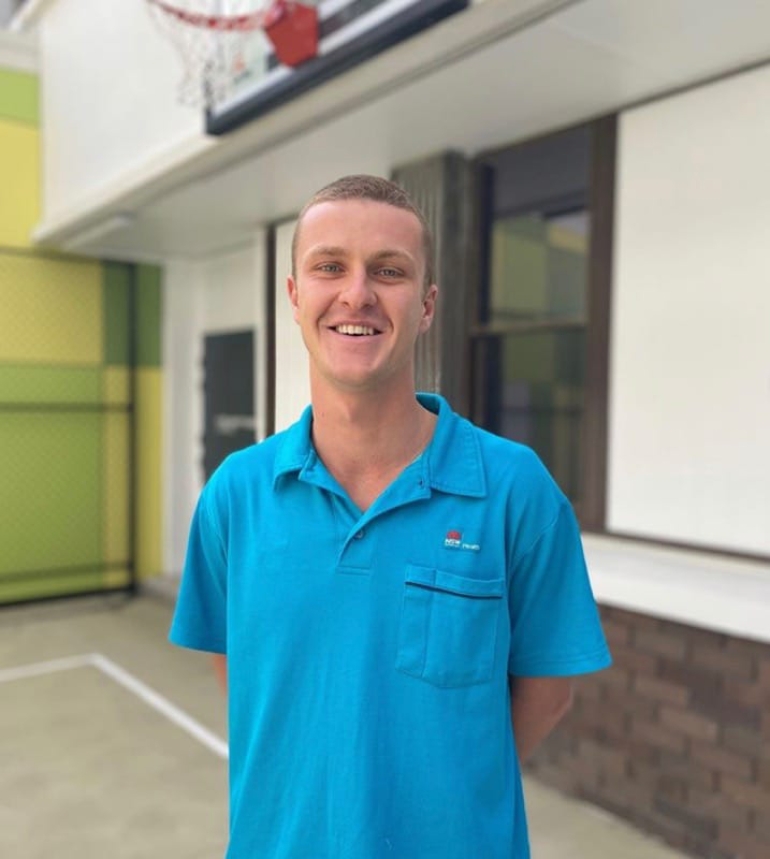
When I interviewed Jarrad Fisher about his journey from student clinician to clinician innovator, I was prepared for a narrative of gritty determination in the face of adversity. What I wasn’t prepared for was a story of collegiality that would make Hairy Maclary feel a little envious.
As a 4th year student occupational therapist on placement at the Prince of Wales Hospital, Jarrad was working in The Acute Stroke Unit (ASU), training to assess the hand and arm function of patients.
‘There is a standardised battery of assessments such as the nine-hole peg test, where the patient is asked to move nine pegs from a shallow dish into nine holes against the clock. These quantitative results can be combined with the therapist’s subjective judgement to paint a picture about a patient’s relative function.
But these tests don’t tell the whole story. As a student, I started thinking about using motion capture to monitor patients completing daily activities like reaching for a cup or brushing their hair. We already use these activities to assess functionality, but we haven’t yet found a way to generate quantifiable data from completing the complex movements of everyday life.’
And so, what came to be called Functional Upper Limb Movement Assessment (FULMA) was born. Jarrad shared the idea with his student supervisor, Ross Black, and he responded, ‘You need to do this, how can we support you?
Ross turned out to be more than supportive. He explained how research could be integrated with a clinical career, pushed Jarrad to enter the idea into a Pitch Plus competition, highlighted the importance of collaboration and suggested contacting an expert software engineer.
And so it was that Jarrad met Professor Wanqing Li from the School of Computer Science & Software Engineering at the University of Wollongong. Wanqing got excited about the possibilities, the concept acquired proper software credentials, and they started applying for seed funding.
In 2021, the pair met Professor Craig Anderson and Dr Xiaoying Chen of the George Institute for Global Health, experts in clinical neurology, and from there the idea snowballed into a fully-fledged clinical research project complete with an expert team, a three-way collaboration agreement and sponsorship from the George Institute. I had the privilege of meeting Jarrad to discuss intellectual property management within the public health system, and we’ve been friends and colleagues ever since.
The current FULMA technology solution uses 3D computer vision and machine learning to trace and measure the movement of patient’s arms, shoulders and wrists. The moon-shot is a commercial app that uses a smart phone camera to make quantitative rapid determinations of the range of movement a stroke patient has, which can be regularly updated to track rehabilitation.
Now, Jarrad is in his 7th year at the Prince of Wales Hospital as an occupational therapist. He says that what he most loves about being an OT is the privilege of being part of his patients’ rehabilitation journey. He’s also a PhD student registered at UNSW under the supervision of Professor Craig Anderson, Dr Xiaoying Chen and Professor Natasha Lannin.
When we tell stories of innovation, the product gets the lion’s share of attention. The people are often absent or crudely drawn sketches.
I’m not alone in contending that clinician innovators are the most important product of such a journey because they often become serial inventors and passionate advocates, with daily exposure and intimate understanding of health technology use, and their value goes well beyond the confines of a single invention.
If you’re a clinician who would like to be involved in any aspect of health technology innovation, be it identifying an unmet medical need, a medical device that needs rethinking or you’re just curious to hear more about what’s going on, we would love to hear from you.
Please reach out to s.palmer@unsw.edu.au or via the RHIP website (rhip.org.au).
Dr Stephen Palmer, Industry & Innovation Lead
Randwick Health & Innovation Precinct